Showing posts with label geek's guide. Show all posts

October 14, 2007

Geek's Guide to Shabana Azmi, part 4 - Eh...

This is the fourth and final segment of the Geek's Guide to Shabana Azmi. To learn more about the Geek's Guide, please visit the Introduction, as well as Part 1 - Iconic roles, Part 2 - Cog in a brilliant machine, and Part 3 - Solid starrers.


Eh...
I either don't like these films, or I feel that Shabana ji was wasted in them - or both.

Avtaar (1983). I think one of those films whose approach is lost in translation to me, as someone who is not Indian, because it was a commercial success. I also understand it was the inspiration for the recent film Baghban. To me, its handling of an important theme - that young people should respect their elders - fell somewhere between peculiar and disturbing. There was nothing wrong with Shabana ji's performance in it - well, except the excruciating "Din mahino saal" - but the role could have been adequately filled by any of her contemporaries. As for "Din mahino saal," I can only conclude that Shabana ji was made to look ungraceful on purpose.

Pestonjee (1988). Not a bad film - actually quite a good film, and an essential for fans of Naseeruddin Shah or Anupam Kher, both of whom are outstanding. Kirron Kher has a fantastic vampish turn as well. But I just don't like the way Shabana ji was used. The role, in my opinion, didn't play to her strengths at all.

Ek doctor ki maut (1991). I feel bad putting Ek doctor ki maut in this category; it's not that bad, and Shabana ji is quite good in it. But it doesn't really fit into any of the other categories either. It ends up here, I think, because I'd rewatch any of the films in the other three categories before rewatching this one - but it arguably does not deserve such a lowly fate.

Morning Raga (2004).
Ugh. The trouble with Morning Raga is that it's just not a very good movie. Shabana ji played her part very well, but that wasn't enough to save the amateurish feel of the whole project. A weak script, weak directing, weak music, and most of all weak acting - it's Shabana ji giving a master class to a bunch of kids who can't act. I do think it's a good thing that Shabana ji gets involved in projects like this, where she lends her skill and cachet to a new or unknown filmmaker whose talent she believes in. Unfortunately, the result isn't always a great film.

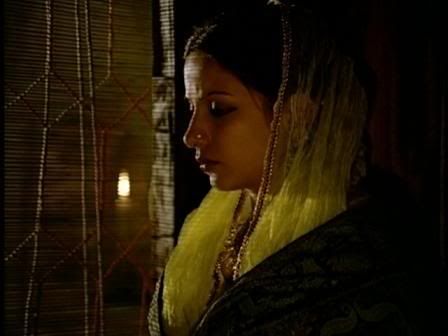
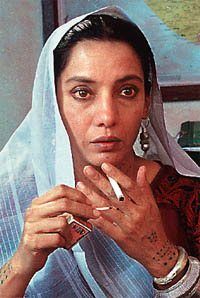
Umrao Jaan (2006). Shabana yes, rest of the film not so much. I can't say it better than the lady herself: "I loved the clothes I wore in the film and my scenes were delicious. I liked myself." If it hadn't been for the sentimental appeal of reprising her mother's role from the 1981 Muzaffar Ali classic, I wonder whether Shabana ji would have come within 100 yards of this project. Still, at least it gives us pictures like this one:

September 9, 2007

Geek's Guide to Shabana Azmi, part 3 - Solid starrers

This is the third segment of the Geek's Guide to Shabana Azmi. To learn more about the Geek's Guide, please visit the Introduction, as well as Part 1 - Iconic roles and Part 2 - Cog in a brilliant machine.


SOLID STARRERS

These are the films which, while Shabana ji's character can be considered a focus of the story, are for whatever reason slightly less awesome than the iconic roles identified in part 1. These are all still good films that would be enjoyed by any admirer of Shabana ji's; they just, for whatever reason, don't rise to the level of iconic as the movies of part 1 of the Geek's Guide do.

Nishant (1975). The best thing about Shyam Benegal's second film is that it features a huge crowd of baby art-house giants - Naseeruddin Shah, Kulbhusan Kharbanda, Smita Patil, Shabana Azmi, Anant Nag, Girish Karnad - all in their second or third film out of school. Shabana ji plays a schoolmaster's wife, abducted for the amusement of the youngest brother of the local zamindar. Her performance is more volatile and less introspective than in Ankur, but I think Ankur is a tighter and better film.

Fakira (1976). Young Shabana ji in a full-on masala role, lead heroine opposite her girlhood idol Shashi Kapoor. It's a terrific ride for someone who came to know Shabana ji the way I did, as art-house ki rani; there are several tasty romantic songs, including one that is pretty naughty, and a vicious catfight between Shabana and Aruna Irani. The payoff is a little unsatisfying - Shabana spends the film's climax tied up inside of a statue waiting for Shashi to save her - but it's a fun film nonetheless.

Swami (1977). A bright and promising student has her spirit broken by the weight of tradition and duty. Shabana ji won a Filmfare award for this performance and so it may arguably belong in part 1. I don't put it there, though, because unlike some of the other oppressed characters Shabana ji played later in life, there's no move toward transcending that oppression; Her character in Swami just gives in to it. The film may be subversive in showing her miserable for having done so; I can't make up my mind. At any rate, Shabana ji is delicious in it, especially in the film's first 45 minutes, when her character is happy and excited by the promise of love and knowledge.

Sparsh (1980). There were some things that were very sweet about this film, but as a movie about a proud, independent blind fellow (Naseeruddin Shah) and his sighted girlfriend (you-know-who), it doesn't quite avoid the trap of waxing preachy. Still, it has sweet moments that make it worth watching - the romance is delicious. This film might arguably be semi-iconic; in an alternate universe it might have landed in part 1 of the Geek's Guide. Shabana ji's character has a little of that quiet intensity, though it's young and raw; with a different star Sparsh would have been a radically different film.

Ek din achanak (1989). This is a quiet psychological drama in which not a lot happens; it's mostly about what's going on in people's heads. Shabana ji's character's father disappears one day, and his family tries both to figure out what happened to him and to get used to life without him. Shabana ji's introspective character resembles some of her other contemplative roles, but lacks the intensity, the fire, of the most compelling ones.

Tehzeeb (2003). This is a terrific film. It's great fun to see Shabana ji as a narcissistic and bitchy (but not unredeemable) show-biz character. As a younger woman she might have come across as shrill in such a role; pentegenarian Shabana suits it perfectly, though, bringing her own accomplished presence to bear. The character has an air not just of arrogance, but of arrogance earned; not entirely unlike the actor herself, I am inclined to think. Unlike the actor, though, this character doesn't quite grasp that the world does not revolve around her. And even though her character is a rock star, the themes of the film will resonate for any adult woman who has a mother.

August 17, 2007

Geek's guide to Shabana Azmi, part 2 - cog in a brilliant machine

Welcome to the second chapter of the Geek's Guide to Shabana Azmi - Cog in a Brilliant Machine. To read more about the Geek's Guide check out the Introduction and Part 1 - Iconic Roles.


COG IN A BRILLIANT MACHINE

This category is for outstanding films in which Shabana ji's character was not the focus of the story. Some are ensemble films that have no single central character; in others, Shabana ji had more of a supporting role - but they are all fabulous, excellent films, among my favorites.

Amar Akbar Anthony (1977). Three guys, three girls, and all sorts of syncretic symbolism, wrapped up in a rollicking masala package. Our girl had the least screen time of the six principals, but it's not easy to forget her hitching a ride with Vinod Khanna and giving him the hard sell, or taking in the laundry in the scene of domestic bliss in the one little piece of a song that is picturized on her. It's a role that certainly could have been played by just about anyone, but it doesn't matter, since it's a great film that should be seen regardless.

Parvarish (1977). Not quite up to the standard of masala genius set by Amar Akbar Anthony, Parvarish makes up for being a slightly weaker film by offering a much more generous helping of Shabana ji, who here has nearly full co-heroine status. And if you want to see young , raw proto-Shabana trying on the avatar of masala heroine, Parvarish (or the equally trippy Fakira, in which she is the lead heroine) is where you should turn. She plays a pickpocket and small-time con artist named Shabo who, together with her sister Neetu (Neetu Singh of course) set out to mend their ways and win the love of their respective heroes - Vinod Khanna and Amitabh Bachchan - twirling exuberantly through some of the wackiest songs you'll ever see.

Shatranj ke khilari (1977).
Shabana ji has played many a neglected wife in her career, but only in Satyajit Ray's lovely little multi-layered fugue on the sunset of the Mughal imperial tradition is she neglected in favor of a game of chess. It's a small role but a terrifically bitter one, as she attempts ever more drastic gambits to win back her husband's attention. My teacher described this role as one of the "hottest" of Shabana ji's career, and I think it fits - hot-headed, hot-blooded, and smoking hot.

Junoon (1979). As in Shatranj ke khilari, Shabana ji plays a neglected Awadhi wife in this smashing, gritty film by Shyam Benegal; but the similarities end there. Her character is dark, intense, wounded, angry, and nearly powerless, as she attempts to manage her rage when her husband (Shashi Kapoor) proposes to make a second wife out of the young Anglo girl who is his obsession. Her attempts to regain control of her marriage are compelling, and her final scene in the film is bitterly heartbreaking.

Khamosh (1985). This light thriller by Vidhu Vinod Chopra is one of my favorite of Shabana ji's films. Apart from being a great whodunit story, it pokes fun at filmi conventions and screws around with the viewer's sense of reality in some delightful ways. It takes place on the set of a film that stars Amol Palekar, Soni Razdan, and Shabana Azmi - the three actors play themselves, and it's clear they've done so with a healthy sense of humor. The Khamosh version of Shabana Azmi jumps up and down like a schoolgirl when she learns that she's won another National Film Award. She also sleepwalks, reads about herself in gossip magazines, and declares "I don't understand politics."

Dharavi (1992). Shabana ji plays a frustrated and complex woman in Sudhir Mishra's excellent look at daily life in the slums of Bombay. The focus of the story is on her husband, played Om Puri, but her subplots add texture and, in their contrast to Om Puri's character's big dreams and schemes, illuminate some of the quotidian aspects of slum life - fighting for water, working in a sweatshop. It's a sensitive film and she gives a delicate performance - also (on a shallower note) looking her best.

Mrityudand (1997). This is simply a fantastic film. It is primarily Madhuri Dixit's show, and Shabana ji's character - yet another neglected wife - doesn't really get going until the second half. But it's well worth waiting for, as it includes a steamy affair, a defiant verbal smackdown of her husband, a nd even a wet sari scene (!). Shabana ji's climactic scene carries interesting parallels to the climax of the contemporaneous Fire; each is a burst of measured rage from a woman who, after a long life of unquestioning submission, has discovered her autonomy (particularly sexual autonomy). And it's a top-notch film all around.

Hari-bhari (2000). More excellent Shyam Benegal, Hari-bhari presents episodic but intertwining stories about the repercussions of fertility (or its absence) on five women in a Muslim family. Shabana ji's character is more an abused wife than a neglected one, tossed out of her home when she dares, on the advice of her doctor, to suggest to her husband that her difficulty having a son may be due to his deficiency rather than hers. Other stories touch on marriage and sexuality, contraception and religion, and education for women. Shabana ji's character is sad and nearly broken, but there's a streak of fight left in her and she's determined to craft a more autonomous life for her teenage daughter. In one of her standout scenes, she misinterprets the girl's innocent questions and mistakenly concludes - to her horror - that her daughter is pregnant.

15 Park Avenue (2005). I wavered on where to put this film, as it is flawed, and I don't love it as much as the other films in this category. But Shabana ji is great in it, and so is Konkona Sen Sharma - to the extent the weaknesses in the script allow them to be - so here it is. Besides, Shabana ji's character is a physicist; how can I not love that? Hearing that voice lecturing on quantum mechanics - the domain of my previous career - sends shivers up my spine. And it's an interesting character for Shabana ji to play - she's strong and formidable, yet also flawed and damaged, a bitter control freak who cannot manage a personal relationship.

Honeymoon Travels Pvt. Ltd. (2007). This is a delightful, adorable film, and Shabana ji plays a great character with a tragic past and a grounded present. Her character (together with Boman Irani's character) provides an anchor for the movie's light-hearted tone, bringing the gravity of life experience to the ensemble cast, but with enough warmth and humor that the weight isn't unbalancing. She's placid, wry, kind-hearted, and a leader by example - and she dances, too!


August 3, 2007

Geek's Guide to Shabana Azmi, part 1 - Iconic roles

Welcome to the Geek's Guide to Shabana Azmi, part 1 - Iconic roles. For an introduction to the Guide, see this post. You can click on any of the film titles to see the corresponding Filmi Geek review - I've tried to keep the Guide brief by not duplicating what can already be found there.

ICONIC ROLES

These are what I see as Shabana Azmi's career-defining films, the films that encapsulate her essence. They are iconic both of the woman herself and of her place in Hindi film. They are also (not surprisingly) much beloved by me.

Ankur (1974). Shabana ji's first film, and Shyam Benegal's too, Ankur is not just career-defining but genre-defining, setting a standard for Hindi parallel cinema. Shabana ji was fresh out of school, very green, with glamorous aspirations. But she worked very hard at her preparation, and nailed the role of an illiterate villager well enough to snag the first of her five National Film Awards with a performance that is taut and physical. The story is as iconic of Shyam Benegal as the role is of Shabana ji - it explores grand themes of class and caste conflict (as well as the male-female power dynamic) through a close study of the interactions of a very small number of people.

Arth (1982). What a film. The first time I tried to watch Arth, the copy I got from my local grocer turned was defective and wouldn't play. Once I told this story to my teacher. "Ooooh," she said, "that's not good. Don't mess with that movie." Shabana ji's character, Pooja, is inspiring, a woman who has no idea of her own strength until her life falls apart around her. Shabana ji cites Arth as both a personal and professional turning point in her life, and it's not hard to understand why. Thank goodness that she and Mahesh Bhatt had the tenacity to fight for the bold ending when their distributors wanted it softened and traditionalized. Oh, and National Film Award #2 for Shabana ji.

Masoom (1983). A number of very good films feature the pairing of Shabana Azmi with Naseeruddin Shah; their understated styles are well suited to one another and they interact with an ease and naturalness that is very unstylized and believable. Masoom offers Shabana as a grounded character stretched to breaking by tension of strong emotions - pain and anger at her husband's infidelity, and a mixture resentment and maternal compassion toward the innocent boy who is the product of it. Watch with hanky close at hand - there are some truly heartbreaking moments.

Fire (1996). The first time that I saw this film, it resonated on many levels simultaneously; among other things, it was my introduction to Shabana Azmi and can fairly be said to have started me down the path I'm on today, the path that includes Filmi Geek, my involvement with Jaman, my study of Hindi, and so much else. I know some people perceive Deepa Mehta's work as exploitative, as propagating among western audiences denigrating stereotypes of Indian life and culture. I don't see her films that way; her work, Fire and Earth in particular, fed what became my great interest in Indian culture and Indian movies. As for Shabana ji's work in Fire - masterful is not too grand a word to describe it. She takes a quiet, introspective character, a woman of few words, and fills the screen with silent emotion, intensity within stillness. It's a performance as good as any of Shabana ji's National Film Award performances.

Godmother (1999). One of Shabana ji's most entertaining characters, and a performance that netted her fifth National Film Award. Rambhi is an illiterate village woman who enters politics after her husband's assassination, starting out intent on fixing the system from within, but becoming as corrupt as those around her. To give you a sense of the kind of woman Rambhi is, there is a scene in which there is an attempt on her life - all the windows of her car are shot out and she is run off the road. When it's over, she lifts her head, peers over the seat at the destruction, and says, "Politics is a tantalizing game." The method actor in Shabana ji here is on full display, and her performance takes on a broad physicality that was less evident in some of her earlier work.

August 2, 2007

Geek's Guide to Shabana Azmi: Introduction

In a recent post I promised you the Geek's Guide to Shabana Azmi - my non-definitive, entirely subjective categorization of those films of Shabana ji's that I have seen. This post is an introduction to the Geek's Guide.

The Guide breaks Shabana ji's work into four categories. Iconic roles are those career-defining films that encapsulate the essence of Shabana ji's on-screen presence, iconic of both the woman herself and of her place in Hindi films. Cog in a brilliant machine applies to outstanding films in which Shabana ji played a secondary or ensemble role. Solid starrers are films that, even though Shabana ji's character is the focus of the story, are for whatever reason slightly less awesome than those that deserve iconic status. And, finally, there is Eh, a category for films that are just not that great (even Shabana Azmi has been in a few duds), or in which I feel that Shabana ji was wasted.

I emphasize that these categories are subjective, just the result of my own critical thinking about the film's I've seen. I offer the Geek's Guide as a starting point for discussion and exploration. I hope it will be interesting and helpful to those seeking further exposure to Shabana Azmi's career, but who might be unsure where to turn when faced with a filmography of 140 movies spanning three-and-a-half decades. I'll update the Geek's Guide from time to time as I continue watching Shabana ji's films.